Florida67 counties
Sell Land in Florida for Cash
Usable ground matters when pricing Florida land, especially around wetlands. Compare Florida offers with land buyers in our network who purchase property in your county.
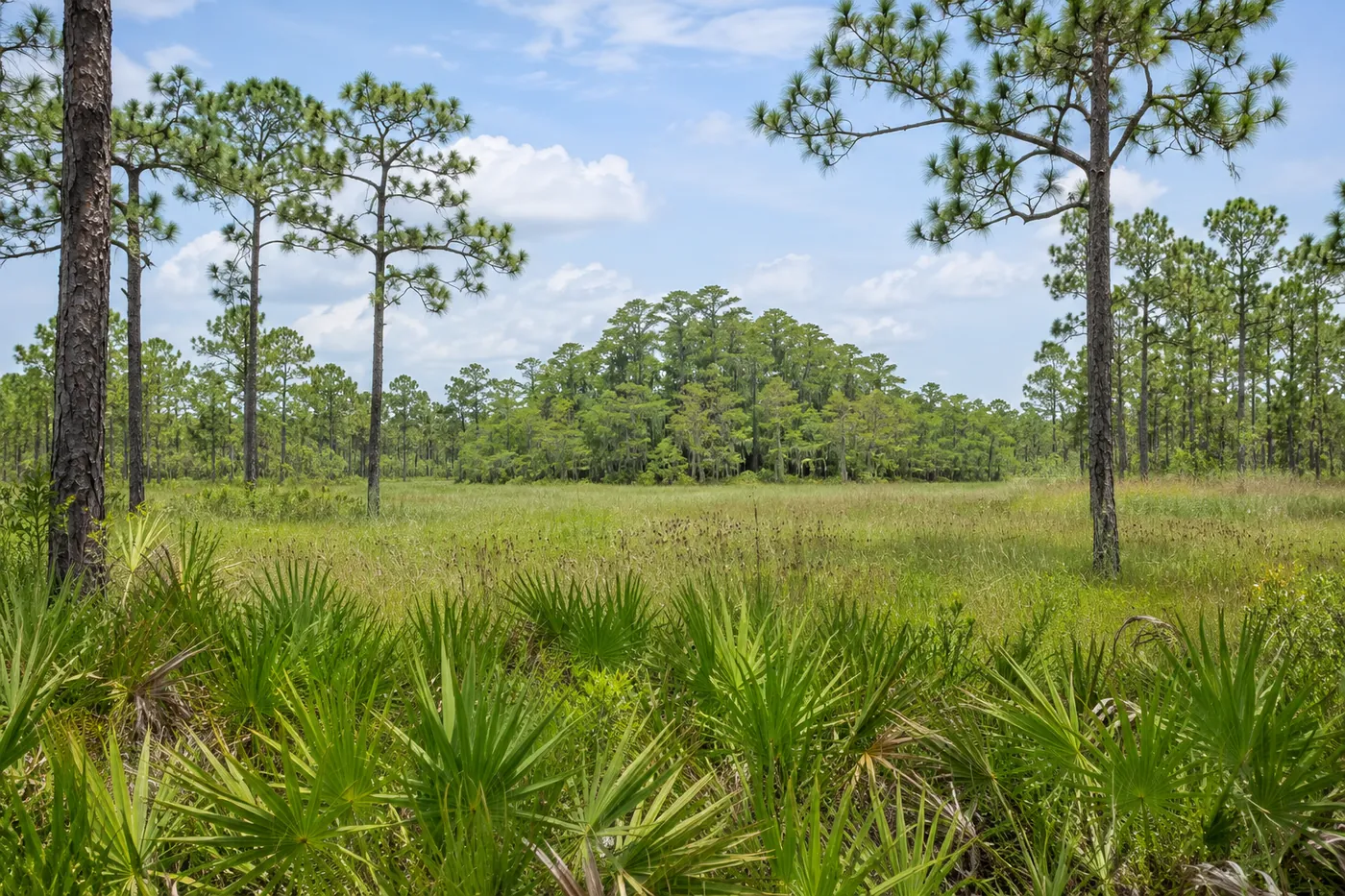
$9,150/ acre
Average farm real estate value, 2026
+5.2% vs 2025
Farm real estate
$9,150/acre
US average $4,500
Cropland
$11,100/acre
US average $6,020
Pasture
$7,650/acre
US average $2,000
1-year change
+5.2%
farm real estate, 2025 to 2026
Source: USDA NASS, Land Values 2026 Summary (2026 averages, released July 31, 2026); Census Bureau county list.
What land is worth in Florida
Florida's USDA agricultural land averages exceed the national averages, but they do not establish a price for your particular vacant lot or rural parcel.
- Florida pasture and cropland have different USDA benchmarks and different practical uses.
- Wetland restrictions can separate total acreage from the area a buyer can use.
- Existing utility service is different from a nearby line requiring a connection.
Read more
Match your parcel to its actual use, then account for drainage, access and development constraints before treating a statewide number as a price target. Florida farm real estate averaged $9,150 per acre in USDA's 2026 data, while cropland averaged $11,100 and pasture $7,650. The corresponding US averages were $4,500, $6,020 and $2,000. These figures describe agricultural categories across the state. Farm real estate also includes buildings, so that series does not represent only bare dirt. A small vacant lot requires parcel evidence beyond the agricultural comparison shown here.
USDA reported Florida farm real estate and cropland averages each rising 5.2% from 2025 to 2026. The pasture average rose 3.4%. A change in a statewide average does not show that every Florida property gained the same amount. Existing road access, dependable water, power connections, timber and proximity to the buyer's intended use affect an individual tract. None of those features is resolved by the statewide percentage.
Usable land matters as much as the outline on a map. A parcel with wet areas or permitting questions calls for a different assessment from land ready for its intended agricultural use. Gather any surveys, environmental records and utility information you already have. Compare offers against the same known conditions, and use an appraisal when you need a parcel-specific valuation rather than a general benchmark for your own planning.
Florida vs. US average, dollars per acre (2026)
Farm real estate
Cropland
Pasture
Florida farm real estate, average per acre
How a land sale works in Florida
Florida closings can be facilitated by a title company or an attorney. The transaction also needs correct deed execution and a documentary stamp calculation.
Read more
Establish the signing arrangements and expense allocation early enough for the buyer and closing professional to address them before closing. The written agreement should identify the parcel and explain the proposed closing costs. Florida's documentary stamp rules generally impose $0.70 per $100 or portion of consideration. Miami-Dade has a different rate and a surtax, with an exception tied to a document conveying only a single-family dwelling. Use the table below to see that distinction. An unimproved parcel should not be assigned the dwelling exception just because a home might later be built.
A contract's payment allocation does not change Florida's rule that all parties to a taxable document are liable for documentary stamps. Deed execution also deserves attention: a freehold conveyance generally requires two subscribing witnesses, with qualifying electronic witnessing provided for by statute. The county clerk of the circuit court records the deed in the Official Records. Title work, signing arrangements and the buyer together determine the closing schedule.
Florida publishes property sale data and assessment rolls, subject to protected-record exemptions. Those records can support price research, but they do not answer which seller disclosures your specific land requires. For disclosure requirements, tax treatment or deed execution, a Florida real estate attorney or title company can address the transaction; a tax professional can address your tax position. Keep known drainage, access and use limitations in the property information you provide.
At a glance
- Florida freehold conveyances generally require signing in the presence of two subscribing witnesses.
- The circuit court clerk maintains the county Official Records where deeds are recorded.
- Documentary stamp liability applies under law even when the contract allocates payment.
| Who handles closing | Either. An attorney or a licensed title agent may facilitate a Florida real estate closing. source |
|---|---|
| Transfer tax | Documentary stamp tax Generally $0.70 per $100 or portion of consideration. sourceMoreMiami-Dade charges $0.60 per $100 or portion, plus a $0.45 surtax that does not apply to a document transferring only a single-family dwelling. Who pays: By law, all parties to a taxable document are liable regardless of their agreement allocating payment; a nonexempt party pays if another party is exempt. |
| Where the deed is recorded | Deeds are recorded in the county Official Records maintained by the clerk of the circuit court. source |
| Are sale prices public? | Florida makes sale-data and assessment-roll files public, subject to confidentiality exemptions for protected records. source |
Back taxes, tax sales and farm valuation in Florida
Florida delinquent taxes can progress from a tax certificate to a separate tax-deed proceeding. Agricultural classification is another issue: eligibility depends on bona fide commercial agricultural use.
Read more
Florida has no personal income tax on an individual's land-sale gain, while business taxes are a separate matter. Property taxes generally become delinquent on April 1 in Florida. A certificate sale follows, and the holder can apply for a tax deed after two years have elapsed since April 1 of the certificate's issuance year. That application leads to a separate public auction process. Treat the certificate and deed stages as different events when reading a tax notice or explaining the status of your parcel to a prospective buyer.
Certificate redemption generally remains possible after issuance and before a tax deed is issued, but it can end earlier when full payment for the deed, stamps and recording has reached the clerk. Redemption requires the face amount plus interest, costs and charges. The practical deadline therefore cannot be reduced to a fixed period after an auction. The table below identifies the process so you can distinguish an unpaid bill from an advanced deed proceeding.
Florida agricultural classification uses agricultural value for land primarily devoted to good faith commercial agriculture. Renewal depends on changes in ownership or use, and land no longer used agriculturally must be reclassified. The classification statute does not set a general multi-year rollback for that conversion. That is different from saying no tax issue can arise. Keep classification records with the parcel information and separate property-tax obligations from the state's lack of personal income tax.
At a glance
- A Florida tax-certificate sale does not itself convey ownership of your land.
- Agricultural classification follows qualifying use rather than a parcel's rural appearance.
- Ownership or use changes affect the procedures for continuing agricultural classification.
| Unpaid property taxes | Property taxes generally become delinquent April 1, followed by a tax-certificate sale. sourceMoreAfter two years have elapsed since April 1 of the certificate's issuance year, its holder may apply for a tax deed, leading to a separate public auction. A person may redeem a tax certificate after issuance and before a tax deed is issued, unless full payment for the tax deed, including documentary stamps and recording fees, has already been made to the clerk. Redemption requires the certificate's face amount plus interest, costs and charges. |
|---|---|
| Farm, timber or open-space valuation | Agricultural classification under Section 193.461: Land used primarily for bona fide agricultural purposes can be assessed on agricultural use rather than its unrestricted value. sourceMoreBona fide agricultural use means good faith commercial agricultural use. Renewal procedures depend on whether ownership or use has changed. Land diverted to nonagricultural use or no longer used agriculturally must be reclassified as nonagricultural; the cited classification statute does not prescribe a general multi-year rollback tax for that conversion. |
| State tax on the gain | Florida does not impose a personal income tax, so an individual's land-sale gain is not subject to Florida personal income tax; business taxes are separate. source |
What buyers check on Florida land
Florida buyers need a realistic picture of drainage, wetlands and the intended use of the property. A parcel's dry appearance alone does not settle those requirements.
Read more
Environmental permitting can apply to work in wetlands and surface waters, as well as upland construction that creates stormwater runoff. Florida's Environmental Resource Permitting program regulates activities including dredging and filling wetlands or surface waters. It also reaches upland construction that generates stormwater runoff. Depending on assigned responsibilities, applications go to the Department of Environmental Protection or a water management district. That matters when a buyer bases an offer on clearing, filling or developing a tract. Ownership of the land does not itself answer what work can be approved.
Your existing records can make the land description more useful. A survey can show the parcel outline, while environmental information addresses a different question about proposed activity. Share permits, prior evaluations and known drainage features without presenting an untested building plan as an established right. A buyer evaluating a pasture tract needs usable grazing area; a buyer evaluating a lot needs evidence relevant to the intended building site and access.
Power, water and access should be described in practical terms. State what is already on the property and what still needs investigation or installation. If the land is wooded, identify existing timber commitments rather than assuming all trees are included without restriction. If several family members hold interests, the ownership record belongs in the review as well. Clear property information helps keep offer comparisons focused on the same tract and conditions.
At a glance
- Environmental Resource Permitting reaches more than projects directly inside a visible wetland.
- Existing maps and permits help distinguish documented conditions from untested building plans.
- Timber, pasture and vacant lots need descriptions suited to their actual use.
- Florida Section 689.01 generally requires a written conveyance of a freehold interest signed in the presence of two subscribing witnesses. source
More
The statute also provides for qualifying electronic witnessing.
- Florida's Environmental Resource Permitting program regulates activities such as dredging and filling wetlands and surface waters, as well as upland construction that generates stormwater runoff. source
More
Applications are handled by DEP or a water management district according to their assigned responsibilities.
Calculator
Estimate your Florida land from USDA averages
Put your Florida acreage into the calculator for an agricultural value benchmark. Use the result alongside usable area, environmental records and the terms each buyer proposes.
Open the full calculatorLand type
Public-data benchmark
-
-
Built from USDA's 2026 state averages for pasture. It is a starting point, not an appraisal or an offer.
See what buyers offerAll 67 counties in Florida
Buyers in our network review land in every one of them. Pick yours on the form.
- Alachua County
- Baker County
- Bay County
- Bradford County
- Brevard County
- Broward County
- Calhoun County
- Charlotte County
- Citrus County
- Clay County
- Collier County
- Columbia County
- DeSoto County
- Dixie County
- Duval County
- Escambia County
- Flagler County
- Franklin County
- Gadsden County
- Gilchrist County
- Glades County
- Gulf County
- Hamilton County
- Hardee County
- Hendry County
- Hernando County
- Highlands County
- Hillsborough County
- Holmes County
- Indian River County
- Jackson County
- Jefferson County
- Lafayette County
- Lake County
- Lee County
- Leon County
- Levy County
- Liberty County
- Madison County
- Manatee County
- Marion County
- Martin County
- Miami-Dade County
- Monroe County
- Nassau County
- Okaloosa County
- Okeechobee County
- Orange County
- Osceola County
- Palm Beach County
- Pasco County
- Pinellas County
- Polk County
- Putnam County
- Santa Rosa County
- Sarasota County
- Seminole County
- St. Johns County
- St. Lucie County
- Sumter County
- Suwannee County
- Taylor County
- Union County
- Volusia County
- Wakulla County
- Walton County
- Washington County
Selling land in Florida: common questions
Still unsure? Send us a question and we will answer it in plain words.
What does USDA say Florida farm land is worth?
USDA's Florida farm real estate average for 2026 was $9,150 per acre. That category includes agricultural land and buildings. It does not price every vacant residential lot or wetland tract. The property's use, available services and practical limitations still need their own review.
Can I sell Florida land with a tax certificate against it?
An outstanding certificate needs to be addressed in the proposed sale and closing review. Florida certificates represent tax liens; a later tax-deed process is separate. Obtain the current status and redemption amount so the buyer and closing professional can evaluate the transaction using the actual obligation.
Is Miami-Dade documentary stamp tax the same as elsewhere in Florida?
No. Miami-Dade uses a different documentary stamp rate and an additional surtax, with an exception for documents conveying only a single-family dwelling. The general Florida rate should not be used automatically for a Miami-Dade land transfer. The closing calculation needs the property's location and transaction details.
Do Florida land deeds need witnesses?
A Florida freehold conveyance generally needs two subscribing witnesses. State law also permits qualifying electronic witnessing. Arrange the deed signing through the closing professional so execution and recording requirements are addressed together, particularly when you are signing from somewhere other than the property's county.
Does Florida agricultural classification continue after I sell?
Continuation depends on qualifying agricultural use and the renewal procedures that apply after ownership or use changes. Rural location alone is insufficient. Land diverted from agriculture must be reclassified, and the agricultural-classification statute does not impose a general multi-year rollback period for that conversion.
Will a Florida buyer pay the calculator value?
The calculator does not set a buyer's offer. It starts with agricultural averages and the details you enter. A buyer also weighs title, usable land, required improvements and purchase costs. You can compare the resulting offers and decline them if the terms do not meet your needs.
Nearby
Other states
Guides
Read before you sell
Get cash offers for your Florida land
Tell us the county and the acreage. Land buyers in our network who buy there will contact you with offers.