Georgia159 counties
Sell Land in Georgia for Cash
Georgia timber acreage can carry harvest limits and conservation commitments. Review your records, then compare offers from land buyers in our network who purchase land in Georgia.
$4,950/ acre
Average farm real estate value, 2026
+4.9% vs 2025
Farm real estate
$4,950/acre
US average $4,500
Cropland
$4,670/acre
US average $6,020
Pasture
$5,100/acre
US average $2,000
1-year change
+4.9%
farm real estate, 2025 to 2026
Source: USDA NASS, Land Values 2026 Summary (2026 averages, released July 31, 2026); Census Bureau county list.
What land is worth in Georgia
Georgia's USDA figures provide agricultural comparisons for your parcel, not a price schedule for every tract. The state pasture average exceeds its cropland average.
- Compare Georgia cropland with cropland, rather than treating every agricultural series as interchangeable.
- State averages do not separately price your standing timber or a proposed homesite.
- Water features and access documents help explain differences between otherwise similar acreage totals.
Read more
Timber value, streamside limits, available services and the amount of usable ground can change how a buyer evaluates your acres against those broad figures. The 2026 USDA average for Georgia farm real estate was $4,950 per acre. Pasture averaged $5,100, while cropland averaged $4,670. National averages were $4,500 for farm real estate, $2,000 for pasture and $6,020 for cropland. Georgia was above the national comparison for farm real estate and pasture, but below it for cropland. The farm real estate series includes buildings, which matters when you are comparing it with unimproved property.
USDA's Georgia farm real estate average rose 4.9% from 2025 to 2026. Over that same interval, cropland increased 3.3% and pasture increased 4.1%. These are movements in the published averages. They do not establish an increase for your individual tract or show what a particular cash buyer will pay. Land with documented access, usable water and available power presents a different calculation from a tract needing those matters resolved.
A practical price discussion includes the property's location and the work required for its intended use. Standing timber, agricultural improvements and ground constrained by waterside buffers should be described separately. Existing surveys and use records can explain more than the acreage total. Compare the buyer's purchase terms with a listing plan using the same assumptions about preparation, costs and usable area. A parcel appraisal offers another way to examine value beyond a statewide agricultural average.
Georgia vs. US average, dollars per acre (2026)
Farm real estate
Cropland
Pasture
Georgia farm real estate, average per acre
How a land sale works in Georgia
A Georgia attorney must handle the legal closing and the preparation or facilitation of conveyance documents for another person. Agree on those responsibilities before comparing net proceeds.
Read more
The seller is legally liable for the transfer tax, although the contract can allocate payment to the buyer. The purchase agreement should give the closing attorney a clear account of the property and the terms. Any timber rights, ownership questions or existing use commitments need to match what the buyer expects to receive. Georgia treats the required conveyance services as legal work. A cash purchase does not remove that requirement, nor does it settle title questions. The closing date depends on completion of the necessary work and the buyer's performance.
Georgia's transfer tax starts at $1 for the first $1,000 or fractional part, with $0.10 for each additional $100 or fractional part of the sale price. The law places liability on the seller, while parties frequently agree that the buyer pays. The table below presents the tax and recording details. A contract allocation should be clear enough that the expected closing statement reflects the agreement rather than an assumption about customary payment.
The superior court clerk records the deed, and Georgia's Clerks' Authority provides searchable real estate and PT-61 transfer information. Some search functions require a paid account. Sale records can assist a comparison, but do not establish the disclosure requirements for your vacant tract. Have a Georgia real estate attorney address the parcel's disclosures and sale terms, and use a tax professional for questions about gain or a conservation-use obligation.
At a glance
- The superior court clerk records the deed in the county containing the property.
- Georgia transfer records include searchable real estate and PT-61 sales information.
- The closing attorney can identify which disclosures apply to your particular parcel.
| Who handles closing | Attorney. A licensed Georgia attorney must handle the closing and preparation or facilitation of conveyance documents for another person. sourceMoreThe Georgia Supreme Court treats these services as the practice of law. |
|---|---|
| Transfer tax | Real estate transfer tax $1 for the first $1,000 or fractional part, plus $0.10 for each additional $100 or fractional part of the property's sale price. sourceMoreWho pays: The seller is liable by law, although the parties frequently agree in the sales contract that the buyer will pay. |
| Where the deed is recorded | Deeds are recorded with the clerk of the superior court in the county where the property is located. source |
| Are sale prices public? | Georgia's Clerks' Authority makes real estate and PT-61 transfer sales information searchable, with some search features requiring a paid account. source |
Back taxes, tax sales and farm valuation in Georgia
Georgia tax-deed redemption does not automatically expire after the first year. Conservation-use covenants create a different obligation that can affect a voluntary sale of your land.
Read more
Identify both the delinquency status and any covenant before evaluating an offer as the amount you will receive. Unpaid Georgia property taxes can result in a levy, required advertising and a sale conveying a tax deed. In the ordinary process, an owner or another person with a qualifying interest can redeem during the first 12 months after sale. After 12 months, the purchaser can begin the statutory notice procedure to foreclose redemption. Passing that anniversary alone does not terminate the right. The table below describes this ordinary process rather than alternative judicial foreclosure procedures.
Conservation Use Assessment requires qualifying property to remain under a ten-year covenant. A breach generally requires repayment of twice the tax savings received during the covenant up to the breach. A sale is not necessarily a breach: buyer-continuation rules and exceptions require separate qualification. Identify the covenant and the purchaser's intended use before assuming it transfers without consequence. Georgia treats capital gains as income, so an offer, closing deductions and the tax result are distinct parts of your calculation.
At a glance
- An ordinary Georgia tax deed remains redeemable until that right is lawfully foreclosed.
- Conservation Use Assessment exchanges preferential valuation for a qualifying ten-year use covenant.
- Georgia taxes capital gains as income rather than through a separate gains-tax system.
| Unpaid property taxes | Unpaid property taxes can lead to levy, required advertising and a tax sale at which the buyer receives a tax deed. sourceMoreThe deed remains subject to redemption until that right is lawfully foreclosed. In the ordinary tax-deed process, the owner or anyone with a right, title, interest or lien can redeem during the first 12 months after sale. After 12 months, the purchaser may begin the statutory notice process to foreclose redemption; the right does not end simply because the first year has passed. |
|---|---|
| Farm, timber or open-space valuation | Conservation Use Assessment: Qualifying conservation-use property receives preferential valuation in exchange for maintaining a qualifying use under a ten-year covenant. sourceMoreA covenant breach generally requires repayment of twice the tax savings received over the covenant up to the breach. Sale and buyer-continuation exceptions require separate qualification; this summary does not treat every sale as an automatic breach. |
| State tax on the gain | Georgia taxes capital gains as income rather than under a separate capital-gains tax system. source |
What buyers check on Georgia land
Georgia timber and waterside acreage need records that explain what can be sold, harvested or disturbed. Standing-timber sales have a reporting requirement through the property-tax system.
Read more
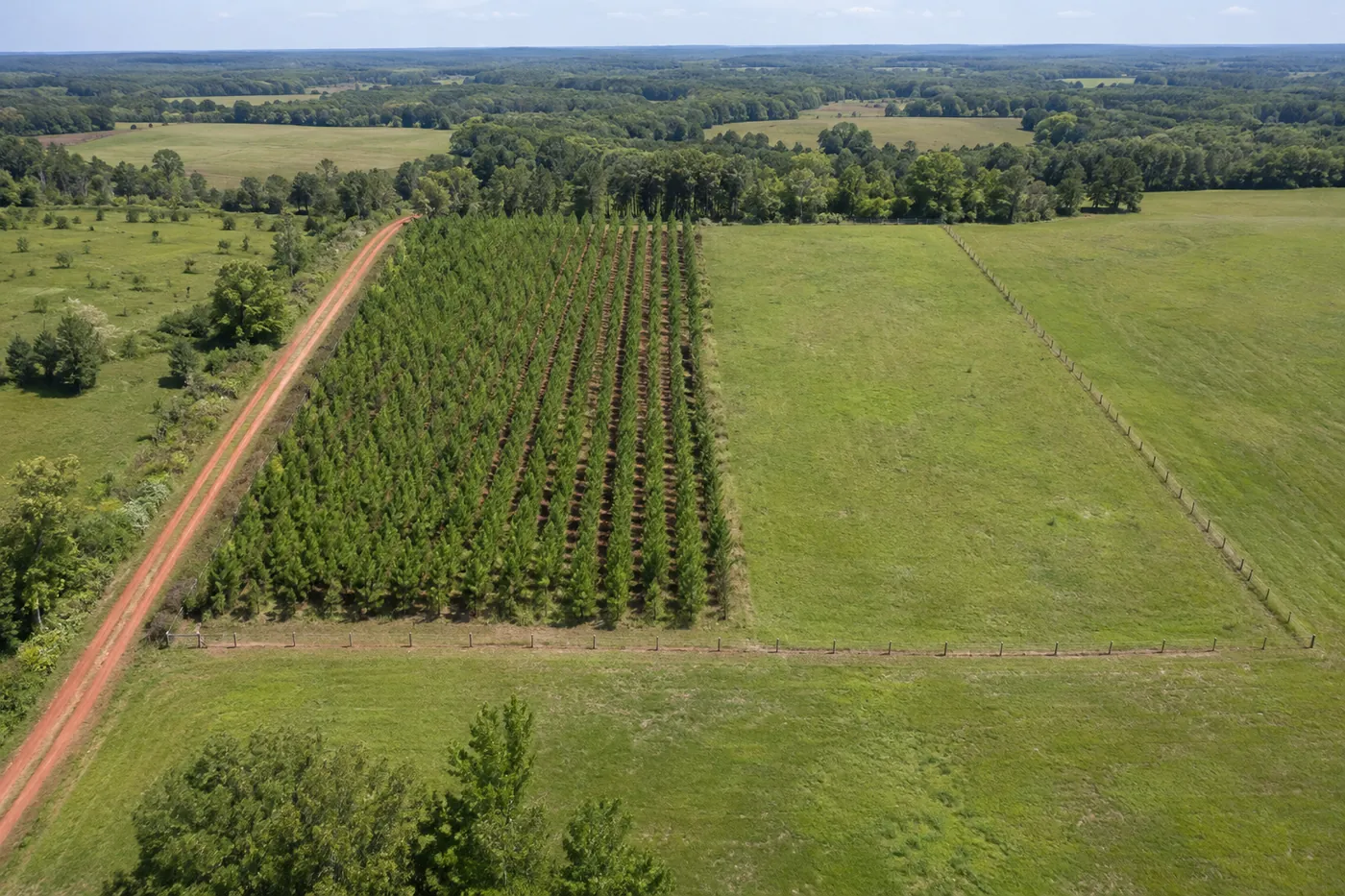
Stream and coastal marsh buffers fall under distinct state permitting categories, so a single assumption about waterside setbacks can misstate the property's usable area. Georgia requires a PT-283T Report of Timber Sale or Harvest when standing timber is sold or harvested. The Department of Revenue provides the form for filing through the property-tax system. For a land sale, existing timber-sale agreements and harvest records help establish what the buyer is actually purchasing. Describe any known timber commitments instead of treating a wooded aerial image as proof that all standing timber is available without restriction.
Georgia's Environmental Protection Division maintains different buffer-variance applications for 25-foot vegetative buffers on warm waters, 50-foot buffers on trout waters and 25-foot buffers on coastal marshlands. These categories concern disturbance near different types of waters. They should not be combined into a single universal setback for every Georgia parcel. When an offer relies on clearing or developing waterside ground, the water classification and proposed disturbance need to be part of the assessment.
The broader property review still includes access, water, power and sewage suitability. A buyer evaluating farm ground needs a usable-area description; someone pricing a timber tract needs a clear account of the trees and related agreements. For family land, identify the owners shown in the deed records and any known ownership questions. These details make it easier to compare proposed agreements because each buyer is working from the same account of the parcel.
At a glance
- Standing timber sale or harvest requires Georgia's PT-283T reporting form.
- Warm-water, trout-water and coastal-marsh buffers are separate state variance categories.
- A buyer needs usable ground and access information alongside the total wooded acreage.
- Georgia requires a PT-283T Report of Timber Sale or Harvest upon sale or harvest of standing timber. source
More
The Department of Revenue supplies the form for filing through the property-tax system.
- Georgia EPD maintains separate buffer-variance applications for 25-foot vegetative buffers on warm waters, 50-foot buffers on trout waters, and 25-foot buffers on coastal marshlands. source
More
These are distinct state permitting categories relevant to disturbance of waterside land.
Calculator
Estimate your Georgia land from USDA averages
Run a Georgia acreage estimate before reviewing offers. Keep timber commitments, usable land and conservation-use obligations beside the result so the benchmark stays connected to your property.
Open the full calculatorLand type
Public-data benchmark
-
-
Built from USDA's 2026 state averages for pasture. It is a starting point, not an appraisal or an offer.
See what buyers offerAll 159 counties in Georgia
Buyers in our network review land in every one of them. Pick yours on the form.
- Appling County
- Atkinson County
- Bacon County
- Baker County
- Baldwin County
- Banks County
- Barrow County
- Bartow County
- Ben Hill County
- Berrien County
- Bibb County
- Bleckley County
- Brantley County
- Brooks County
- Bryan County
- Bulloch County
- Burke County
- Butts County
- Calhoun County
- Camden County
- Candler County
- Carroll County
- Catoosa County
- Charlton County
- Chatham County
- Chattahoochee County
- Chattooga County
- Cherokee County
- Clarke County
- Clay County
- Clayton County
- Clinch County
- Cobb County
- Coffee County
- Colquitt County
- Columbia County
- Cook County
- Coweta County
- Crawford County
- Crisp County
- Dade County
- Dawson County
- DeKalb County
- Decatur County
- Dodge County
- Dooly County
- Dougherty County
- Douglas County
- Early County
- Echols County
- Effingham County
- Elbert County
- Emanuel County
- Evans County
- Fannin County
- Fayette County
- Floyd County
- Forsyth County
- Franklin County
- Fulton County
- Gilmer County
- Glascock County
- Glynn County
- Gordon County
- Grady County
- Greene County
- Gwinnett County
- Habersham County
- Hall County
- Hancock County
- Haralson County
- Harris County
- Hart County
- Heard County
- Henry County
- Houston County
- Irwin County
- Jackson County
- Jasper County
- Jeff Davis County
- Jefferson County
- Jenkins County
- Johnson County
- Jones County
- Lamar County
- Lanier County
- Laurens County
- Lee County
- Liberty County
- Lincoln County
- Long County
- Lowndes County
- Lumpkin County
- Macon County
- Madison County
- Marion County
- McDuffie County
- McIntosh County
- Meriwether County
- Miller County
- Mitchell County
- Monroe County
- Montgomery County
- Morgan County
- Murray County
- Muscogee County
- Newton County
- Oconee County
- Oglethorpe County
- Paulding County
- Peach County
- Pickens County
- Pierce County
- Pike County
- Polk County
- Pulaski County
- Putnam County
- Quitman County
- Rabun County
- Randolph County
- Richmond County
- Rockdale County
- Schley County
- Screven County
- Seminole County
- Spalding County
- Stephens County
- Stewart County
- Sumter County
- Talbot County
- Taliaferro County
- Tattnall County
- Taylor County
- Telfair County
- Terrell County
- Thomas County
- Tift County
- Toombs County
- Towns County
- Treutlen County
- Troup County
- Turner County
- Twiggs County
- Union County
- Upson County
- Walker County
- Walton County
- Ware County
- Warren County
- Washington County
- Wayne County
- Webster County
- Wheeler County
- White County
- Whitfield County
- Wilcox County
- Wilkes County
- Wilkinson County
- Worth County
Selling land in Georgia: common questions
Still unsure? Send us a question and we will answer it in plain words.
Must a Georgia attorney handle my land closing?
Yes. Georgia requires an attorney to handle the legal closing and conveyance-document services for another person. A cash transaction still needs that work. Identify the proposed closing arrangements in the agreement and provide the ownership and property records needed to address the particular tract.
What is Georgia's average pasture value?
USDA's 2026 Georgia pasture average was $5,100 per acre. It describes pasture across the state rather than the value of your own fields. Water, access, improvements, terrain and usable acreage still need examination. A buyer's offer can therefore differ from acreage multiplied by that average.
Who pays Georgia real estate transfer tax?
The seller is liable under Georgia law, although the purchase contract frequently assigns payment to the buyer. Read that allocation together with the other closing costs. An offer amount alone does not show your proceeds if the agreement leaves you responsible for charges you had assumed the buyer would cover.
Does selling Georgia conservation-use land break the covenant?
A sale does not automatically establish a covenant breach. Buyer continuation and exceptions depend on qualification. A breach generally calls for twice the tax savings received through the breach, making the existing covenant and proposed use material to the sale discussion before an agreement is signed.
Is Georgia tax-sale redemption limited to 12 months?
Not in the ordinary tax-deed process described here. The initial 12 months allows redemption, and afterward the purchaser may begin the required procedure to foreclose that right. Redemption does not disappear solely because the first year has elapsed. Alternative foreclosure procedures can follow different rules.
What records matter when I sell wooded Georgia acreage?
Existing timber agreements, harvest records, surveys and access documents help explain what the sale includes. Georgia requires the PT-283T report for standing timber sale or harvest. Water features also matter because stream and coastal marsh buffer categories can affect disturbance plans and the usable portion of a tract.
Nearby
Other states
Guides
Read before you sell
Get cash offers for your Georgia land
Tell us the county and the acreage. Land buyers in our network who buy there will contact you with offers.